Decoding the DNA of the Silicon Shield: Morris Chang’s Experience Curve Strategy | From a simple BCG insight to a trillion-dollar empire: The evolution of TSMC’s unbeatable moat.
In Morris Chang’s autobiography, there is a little-known turning point that completely altered the competitive rules of the semiconductor industry. While heading the transistor division at Texas Instruments (TI), he met Bruce Henderson, the founder of the Boston Consulting Group (BCG). This encounter handed Chang a strategic weapon—the "Experience Curve"—teaching him how to "price for future costs." Today, we are going to break down this formula to see how it taught Morris Chang to sweep the market during his TI days and ultimately lay the foundation for TSMC's global dominance.
In Chang's memoir, this past event is undoubtedly a critical turning point in the history of the semiconductor industry. At the time, the external consultant hired by TI was Bruce Henderson, the founder of BCG.
The core concept he imparted to Morris Chang was, to be precise, the "Experience Curve," a strategic tool extended from the traditional "Learning Curve."
1. What are the Learning Curve and the Experience Curve?
Although the two are often used interchangeably, there is a subtle difference in management theory:
- Learning Curve: Originating in the aircraft manufacturing industry, it observes that as workers repeatedly perform tasks, the "labor time" required to produce a single unit decreases in a predictable pattern.
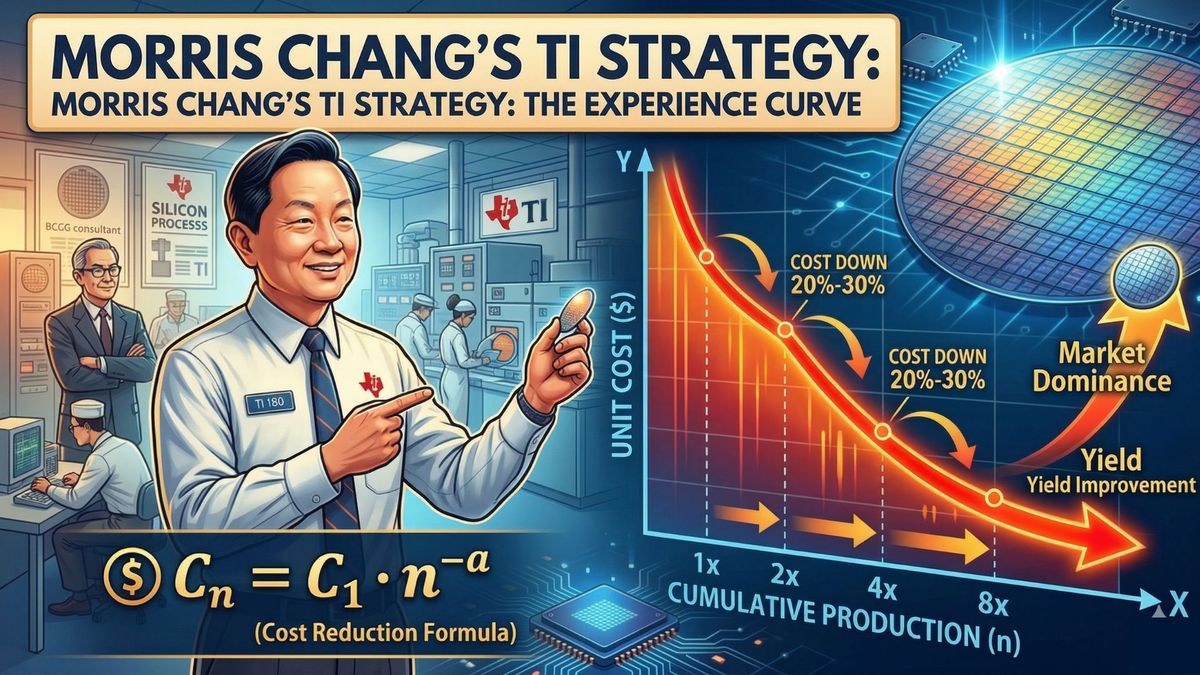
- Experience Curve: BCG expanded upon this concept. It states that whenever the "cumulative production volume" of a product doubles, its "total unit cost" (including R&D, marketing, manufacturing, administration, etc.) typically falls by a fixed percentage (usually 20% to 30%).
2. The Core Formula and Logic
The experience curve can be expressed mathematically with the following formula:
C_n = C_1 x n^{-a}
Where:
- C_n is the cost of producing the n-th unit.
- n is the cumulative production volume.
- -a is the cost elasticity brought about by experience.
Why do costs decrease?
- Practice makes perfect: Employees operate with greater precision.
- Process improvement: Production workflows are optimized, reducing waste (this is crucial for yield improvement in semiconductors).
- Economies of scale: Fixed costs are spread across a larger number of products.
- Product design optimization: With more experience, companies learn how to simplify designs to cut costs.
3. How Did Morris Chang Apply It at Texas Instruments (TI)?
At the time, Chang was responsible for the germanium transistor and, later, the silicon transistor divisions. The most shocking inspiration this theory gave him was the strategy of Forward Pricing:
"Do not price based on current costs; price based on future costs."
- Aggressive Price Cuts: Even if the current production cost was $10, based on the experience curve, Chang predicted that once production reached a certain scale, the cost would drop to $2. Therefore, he proactively set the selling price at $2.50 (even if it meant losing money on every unit sold initially).
- Capturing Market Share: The low price attracted a massive influx of orders, which rapidly accumulated production volume. The increased volume triggered the experience curve, effectively driving the actual cost down below $2.
- Building a Moat: When competitors saw TI's pricing, their low production volumes and high costs meant they couldn't keep up, ultimately squeezing them out of the market.
4. The Profound Impact on the Semiconductor Industry
This logic later became the "Bible" of the semiconductor industry and served as a foundational mindset when Morris Chang founded TSMC:
- Yield is Everything: In semiconductors, the experience curve is primarily reflected in the improvement of "yield rates." The more wafers you cumulatively manufacture, the faster you can correct errors.
- The Bigger Get Bigger: Whoever has the largest production volume stays at the absolute forefront of the experience curve, enjoying the lowest costs and using price to suppress latecomers.
This is precisely why, even with astronomically high R&D costs for advanced nodes (like 2nm), TSMC must continuously expand its capacity. Only with sufficient cumulative production can that "experience curve" keep trending downward.
This piece of consulting advice not only transformed TI but also established the rules of the game for global semiconductor competition for decades to come.
A 48-Year-Old's Adventure: When the "Pioneer of Consulting" Met the "Godfather of Semiconductors"
In the world of investing and entrepreneurship, we often hear that "success must come early," but Bruce Henderson, the founder of BCG, gave us a completely different script.
I. The 48-Year-Old's Gamble: An Entrepreneur Selling "Ideas"
In 1963, to the astonishment of many, a 48-year-old Henderson left a stable executive position at a bank. In that era, this was practically retirement age, yet he chose to start BCG from scratch—with just a desk and a stack of blank paper.
At the time, the corporate world didn't understand the value of a "strategy consultant." Henderson's greatest weapon wasn't doing accounting for companies, but rather his famous "pamphlet marketing." He distilled complex competitive logic into a few pages of profound insights and mailed them to CEOs worldwide. He firmly believed: "What CEOs lack is not information, but a completely new framework for viewing problems." This relentless pursuit of "First Principles" was the exact key that eventually won over Morris Chang.
II. The TI Scene: When the "Greatest Mind" Meets the "Hardcore Engineer"
In the late 1960s, a 30-something Morris Chang, who was aggressively leading the charge at TI, met this consulting titan who was nearly 20 years his senior. This wasn't just a meeting between consultant and client; it was the collision of two "strategic geniuses."
- The Challenge: Chang's transistor division was caught in a brutal price war.
- The Turning Point: Henderson handed Chang a piece of graph paper drawn with a curve. He didn't discuss specific factory operations; instead, he discussed a mathematical phenomenon: "As long as cumulative production volume doubles, costs will predictably decline."
- The Resonance: To the engineer-trained Morris Chang, this chart was an absolute revelation. He instantly realized that competition wasn't just about technological superiority, but a race of "accumulation speed."
Chang later admitted in his autobiography that this logic became the backbone of his future decision-making. His courage to use "loss-leader pricing" to drive out competitors at TI, and his relentless pursuit of "yield and scale" when founding TSMC, both originated from this very conversation with Henderson.
💡 Sunfortzone Core Value Output: What Can We Learn?
This cross-generational exchange leaves modern investors and entrepreneurs with three vital takeaways:
Age isn't a barrier to innovation; insight is: Henderson starting a business at 48 proves that "an explosion following accumulation" is far more powerful than "early impulsiveness." In value investing, we are looking for exactly this kind of management—those who have been tempered by time and can see through the essence of an industry.
Embrace "irrefutable logic": Great strategies are usually very simple. The experience curve formula, C_n = C_1 x n^{-a}, is not difficult in itself. What's difficult is having the courage to firmly execute a long-term strategy based on this logic, even during periods of short-term losses.
Look for companies with a "scale moat": As investors, we should adopt Morris Chang's perspective: Is this company at the cutting edge of the experience curve? Has its cumulative advantage reached a point where competitors "couldn't afford the cost even if they tried to catch up"?
Conclusion:
The meeting of Morris Chang and Bruce Henderson is one of the most beautiful coincidences in semiconductor history. One provided the "theoretical weapon," and the other maximized it into a "trillion-dollar industry." This tells us one thing: A great idea is, in itself, a form of productivity.
The Advantages of Interactive Brokers (IBKR)
Thank you for your valuable time!
If you enjoyed our content, please support us with a Super Thanks and subscribe to our YouTube channel so you can receive more valuable insights.
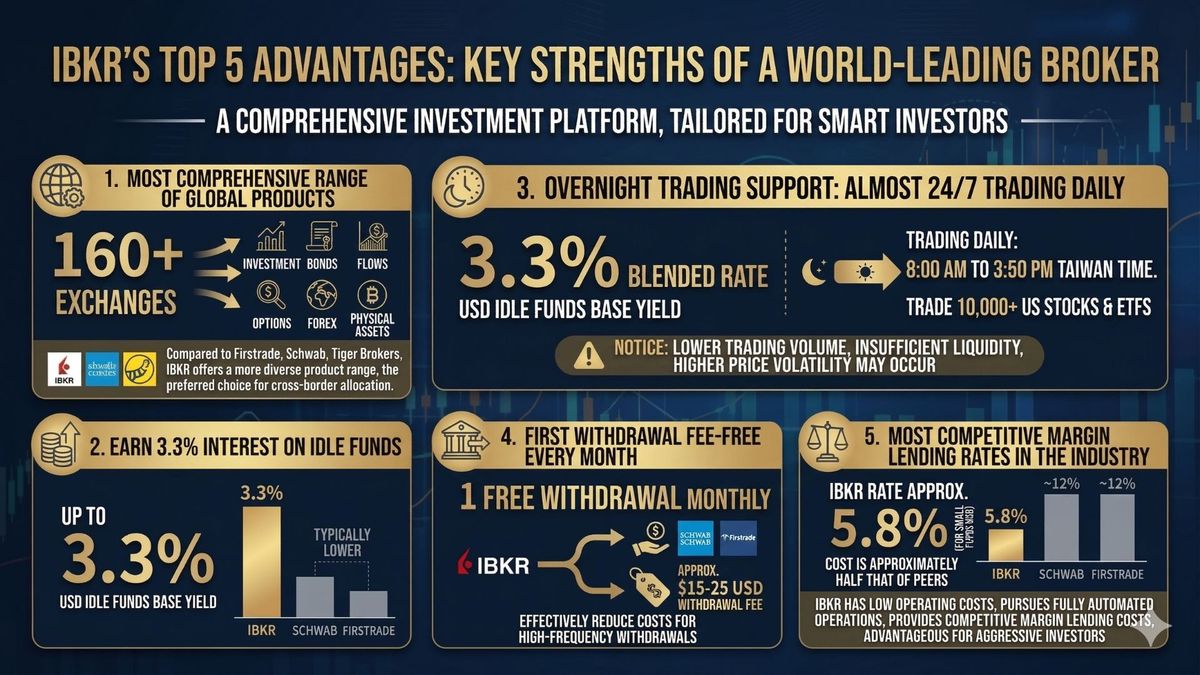
Want to achieve financial freedom? Let's start with a high-quality overseas brokerage! Interactive Brokers is not only the top choice for professional investors but also possesses these 4 overwhelming advantages:
- High Interest on Idle Cash: Earn up to 3.3% on uninvested cash! Let your "cash oxygen" automatically generate rich cash flow for you while you wait empty-handed for a great company.
- Invest Globally with One Account: Supports 160 markets worldwide. Whether you want to buy US-based Tesla or Apple, or European LVMH, you can handle it all effortlessly through a single account!
- Extremely Low Trading Costs: Commissions are as low as $0.0035 per share, with no hidden fees. Every penny saved on trading costs is your future investment profit.
- Professional Trading Tools: The powerful TWS (Trader Workstation) platform provides in-depth data and analysis, satisfying the comprehensive needs of advanced investors.
🌟 Exclusive Account Opening Offer & Beginner Support
If you want to step toward financial freedom with us and expand your investment footprint, click the link below to open your free Interactive Brokers account!

🎁 Exclusive Bonus: By opening an account through our referral link, you can earn $1 in IBKR stock for every $300 deposited, up to a maximum of $1,000 in stock rewards!
👉 [IBKR Exclusive Account Opening Offer Link]
Worried about not knowing how to use it? Don't worry! Here at Sunfortzone, we have created an exclusive discussion community for IBKR. There are many enthusiastic like-minded individuals in the community who will guide you step-by-step on how to deposit/withdraw funds and place orders for stocks worldwide. If you prefer to follow along visually, you can also click to watch my previous video: [IBKR Account Opening Tutorial Video].
👉 [Sunfortzone IBKR Discussion Community]
Welcome to join our community to discuss together first. Wishing you smooth and successful investing!
🙏 Thank you for watching!
If you found this episode helpful, please support us with a "Super Thanks" and subscribe to our YouTube channel. Sunfortzone will continue to bring you more high-value investment insights!