Don't Buy Until You Check This: Buffett & Morris Chang’s "Ideal Board" Rules
When first stepping into the world of value investing, we often focus most of our energy on diving into financial reports and calculating cold, hard numbers like EPS and P/E ratios. This is normal, as it's the fundamental skill of investing. However, in the real business world, no matter how beautiful the financial numbers are, if they lack the backing of good "corporate governance," they might just be castles in the sand. The essence of investing is partnering in a business. The key to whether a company can go the distance and whether it will harm minority shareholders' interests actually lies in the "people" responsible for managing and supervising behind the scenes.
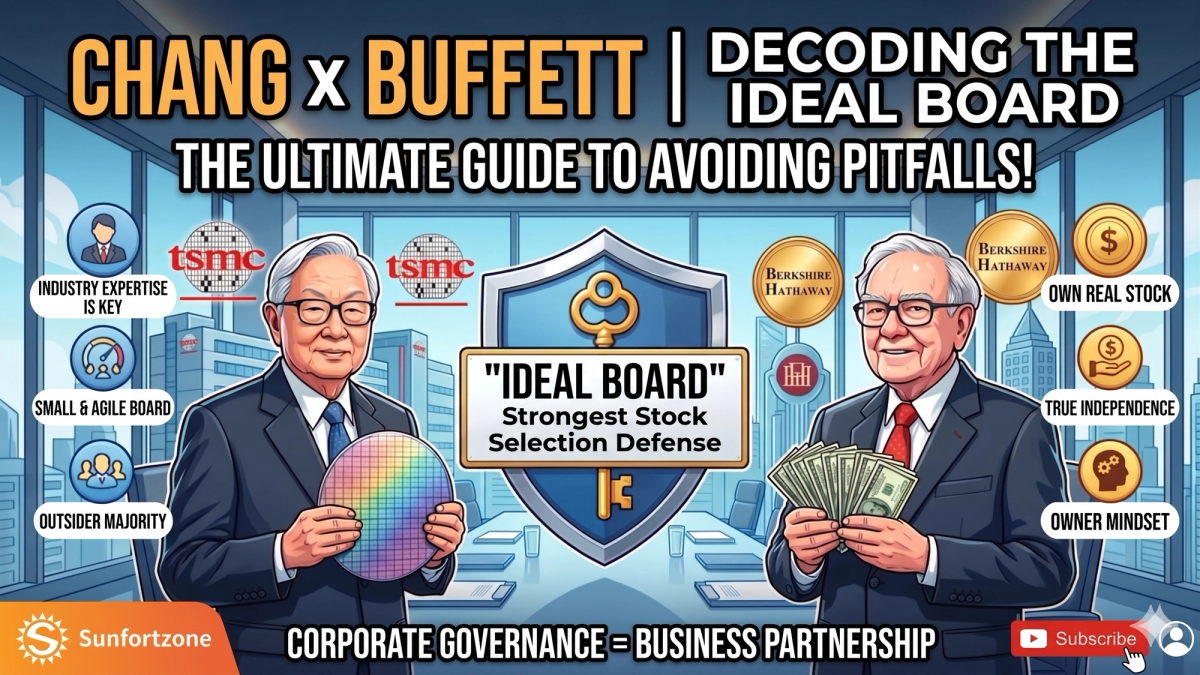
Praised as the godfather of Taiwan's semiconductor industry, TSMC founder Mr. Morris Chang once brilliantly summarized the six major criteria for his "ideal board of directors." This is not only a true reflection of how a top-tier enterprise operates but also an ultimate "stock-picking and pitfall-avoidance guide" tailor-made for us retail investors. Below, let's decode this invaluable master wisdom through the most accessible perspective:
Simply put, Grandpa Chang is telling us: What the board of directors of a good company worth holding long-term should look like. Or more precisely, what the TSMC board of directors should ideally look like.
1. Industry Expertise is Key: Say No to "Figurehead" Directors
- Original Meaning: Directors must understand semiconductors; outsiders shouldn't be chosen.
- Investor's Perspective: The board is there to help shareholders supervise the CEO. If the directors don't even understand the company's products and business model, they can only nod at whatever the CEO says. When picking a company, look at the board roster. If it's filled with politicians and celebrities unrelated to the core business (just there for fame or as window dressing), the company's decision-making quality is at risk.
2. Able to Keep the Boss in Check: Say No to "Rubber Stamps"
- Original Meaning: A director's social standing should be similar to or higher than Morris Chang's, so they won't be controlled by him.
- Investor's Perspective: In many companies, directors are just friends or subordinates of the chairman, and meetings are merely a formality (commonly known as rubber stamps). Directors of a good company must have enough confidence and industry status to dare to bang on the table and say "no" to the boss during meetings. Only then can they prevent a strong-willed CEO from driving the company off a cliff.
3. A Small Group Gets Things Done: Say No to "Mega-Gathering" Meetings
- Original Meaning: The board should have fewer than 10 people. With fewer people, they dare to speak the truth, making it easier to build consensus.
- Investor's Perspective: If the board is too large (e.g., 15 or 20+ people), meetings become formal "mega-gatherings" with no time for in-depth discussion of issues. A lean team is essential for truly profound strategic discussions.
4. Outsiders in Charge: Protecting Minority Shareholders' Interests
- Original Meaning: Independent directors (those who don't work at the company and aren't major shareholders) should hold the majority. A major shareholder's board seats should not exceed their shareholding percentage.
- Investor's Perspective: This is the key to protecting "retail investors" like us! Major shareholders or managers sometimes sacrifice minority shareholders for their own benefit. A majority of "independent directors" acts like objective referees on the field, responsible for supervising the big boss and preventing them from hollowing out the company or lining their own pockets.
5. Strictly Guarding the Books and the Wallet: Establishing Two "Impartial" Committees
- Original Meaning: Establish "Audit" and "Compensation" committees composed of independent directors, and they must play for real (hiring experts at their own expense to audit the books, and holding closed-door discussions on the big boss's salary).
- Investor's Perspective:
- Audit Committee (Guarding the Books): Ensures the company isn't cooking the books. TSMC even hires experts to audit the accounts in advance. This level of rigor means the company's financial reports are pure "gold," giving investors peace of mind.
- Compensation Committee (Guarding the Wallet): Ensures the bonuses paid to executives are reasonable. Many terrible companies are losing money, yet executives still take home huge bonuses. A good company links executive pay to actual performance. Even Morris Chang's own salary had to avoid conflicts of interest and be determined by independent directors.
6. Honest Talk Under the Table: Valuing Substantive Communication Over Formal Processes
- Original Meaning: Official meetings are legally required to be recorded, so people are afraid to voice immature opinions. Therefore, an "off-the-record dinner meeting" is held the night before, allowing everyone to open up, argue, discuss, and even force the CEO to withdraw flawed proposals.
- Investor's Perspective: This shows the "broad-mindedness" of the enterprise's top leader. Many bosses only like to hear good things, but truly outstanding leaders create a safe environment that encourages people to raise doubts. Although we as outside investors cannot see this dinner meeting, it represents a corporate culture of "acknowledging mistakes and brainstorming," which is also the secret to a company's longevity.
Summary for Beginner Value Investors:
Buying a stock means buying a piece of a company. What Morris Chang is really teaching you here is: For a company to be worth a heavy investment and a long-term hold, its top management cannot be an "echo chamber." The accounts must be strictly audited, and there must be a group of experts who dare to speak the truth, acting as gatekeepers for minority shareholders. In the future, when evaluating a company, besides looking at profits, you might want to flip through the "Board of Directors Roster and Operations" in the annual report. This can help you avoid many landmines!
Welcome to Sunfortzone. Our goal is to help value investors better understand the companies they invest in and achieve financial freedom.
If you want to grow on your value investing journey, please subscribe to our YouTube channel to get more valuable content, and join our YouTube membership to support Sunfortzone in continuing to create for you.
Wall Street makes money through frequent trading, while we, as value investors, make money through long-term holding.
[Advanced Stock Selection Defense] The Perfect Board in the Eyes of Oracle Warren Buffett: Finding Gatekeepers Who Are "In the Same Boat" With You
If TSMC founder Morris Chang values the board's "professional defense and governance processes," then Warren Buffett—the greatest investor in history and the helmsman of Berkshire Hathaway—views the board from a perspective that points directly to human nature: "Alignment of Interests" and "Business Common Sense."
For beginner value investors, Buffett's perspective is a shot of adrenaline. He has mercilessly mocked the superficial, formalistic boards of Wall Street many times in his letters to shareholders. In Buffett's eyes, a good company worthy of entrusting your net worth to must have a board with the following four major characteristics:
1. Buying Stock with Their Own Hard-Earned Cash: Say No to "Zero-Risk" Generosity with Other People's Money
- Buffett's Core Philosophy: "Skin in the Game" (Shared risk / Shared interests).
- Investor's Perspective: Buffett deeply despises directors who only collect fat sitting fees or rely solely on stock options "given for free" by the company. He believes that ideal directors must use money from their own pockets to buy the company's stock on the open market, and this investment must represent a significant portion of their personal net worth.
- Pitfall Avoidance Guide: When looking at a company's annual report, flip to the "Directors and Supervisors Shareholding" section. If these high-and-mighty directors aren't even willing to spend their own money to buy a single share of their own company, or if their shareholding percentage is pathetically low, on what grounds should you believe that they will genuinely consider you, the retail investor who invested your hard-earned blood and sweat money, when making decisions?
2. True "Independence" Depends on Whether They Need the Salary
- Buffett's Core Philosophy: "Independent directors" in form are often not independent; true independence comes from financial freedom and the courage to speak the truth.
- Investor's Perspective: The legally mandated "independent directors" (not employed by the company, having no family ties, etc.) are often a joke in Buffett's eyes. He has bluntly stated that if an independent director can comfortably earn a $200,000 fee just by attending a few meetings a year, and this money is important for their standard of living, they will absolutely never dare to offend the CEO who hired them during a meeting.
- Pitfall Avoidance Guide: Buffett's ideal directors should inherently be "wealthy individuals" or successful entrepreneurs who couldn't care less about the board's sitting fees. They sit in that position purely because they are major shareholders, supervising the CEO to protect their own massive assets. This is the "substantive independence" that gives someone the courage to bang on the table without being reduced to a rubber stamp.
3. Understanding the "Essence of Business," Not Just Having a "Gilded Resume"
- Buffett's Core Philosophy: The board needs capital allocators with Business Savvy.
- Investor's Perspective: The boards of many large companies love to collect "name brands"—recruiting retired generals, former high-ranking government officials, or renowned university presidents as directors to make the roster look impressive. But Buffett believes that running a business is not a PR stunt. The core task of a director is to evaluate the CEO's performance and review the company's "capital expenditures and M&A deals." If the directors don't understand the underlying logic of business operations, they have no way of judging whether the CEO is squandering money.
- Pitfall Avoidance Guide: Examine the backgrounds of the board members. The best directors are usually outstanding business operators or capital allocators themselves. They don't need to understand cutting-edge technical details (that's the manager's job), but they must be able to read the business realities hidden behind the financial statements.
4. Acting as an "Owner" of the Business, Firmly Rejecting Wall Street's Short-Term Pressure
- Buffett's Core Philosophy: Directors should think like a boss who truly owns the company, not like a short-sighted passenger.
- Investor's Perspective: Many mediocre boards spend every day worrying about whether next quarter's financial reports will meet Wall Street analysts' expectations, even forcing the CEO to slash R&D expenses or cook the books to achieve this. Buffett's favored boards protect the company's long-term moats like a family heirloom. They have the confidence to tell the market: "We don't care about this month's stock price fluctuations; we only care about the company's profitability ten years from now."
- Pitfall Avoidance Guide: If a company's management and board spend all day hyping up concepts in the media and releasing flashy but unrealistic short-term forecasts, it usually means they lack an "owner's mindset." Truly outstanding boards are often low-profile, pragmatic, and focused on long-term value creation.
Practical Summary for Beginner Value Investors:
Combining Morris Chang's "governance processes" with Warren Buffett's "alignment of interests," we have pieced together the ultimate filter for value investors to examine corporate management:
- Look at Shareholdings: Have the directors used their own money to buy their own company's stock?
- Look at Backgrounds: Do the directors genuinely understand business operations, or are they just a lineup of political and business figureheads?
- Look at Compensation: Is the directors' compensation structure deeply tied to the company's long-term profitability (rather than short-term stock prices)?
Before you buy a stock next time, imagine the company as a corner restaurant you are going to invest in as a partner. Would you want the partner sitting there managing the books and supervising the manager to be an aloof celebrity who hasn't invested a dime and only collects a stipend? Or would you want a shrewd, capable, and outspoken boss who has staked their entire net worth on this shop?
The answer is self-evident, and this is exactly the unadorned, profound truth of value investing.
"That concludes today's sharing. If you have a deeper interest in Mr. Morris Chang's business philosophy and corporate governance, and want to further excavate the underlying business logic of this semiconductor godfather, I highly recommend everyone to read The Autobiography of Morris Chang.
This book not only details his fascinating journey of building the 'sacred mountain protecting the nation'—TSMC—from scratch, but it also hides many great business wisdoms like the ones we discussed today, which are worth chewing over repeatedly to protect our principal as value investors. I've placed a special link to this book in the description box below. I recommend everyone click on it and take a copy home to study carefully.
Finally, thank you for your valuable time in watching until the end! If you enjoyed our content today, please support us with a 'Super Thanks' and subscribe to our YouTube channel, so you can be the first to receive more valuable investment content.
We are Sunfortzone, accompanying you on a steady path in your value investing journey. See you in the next video! Bye-bye!"